.
livello elementare
.
ARGOMENTO: GEOLOGIA
PERIODO: XX SECOLO
AREA: OCEANO PACIFICO
parole chiave: oceanografia, minerali, sfruttamento consapevole
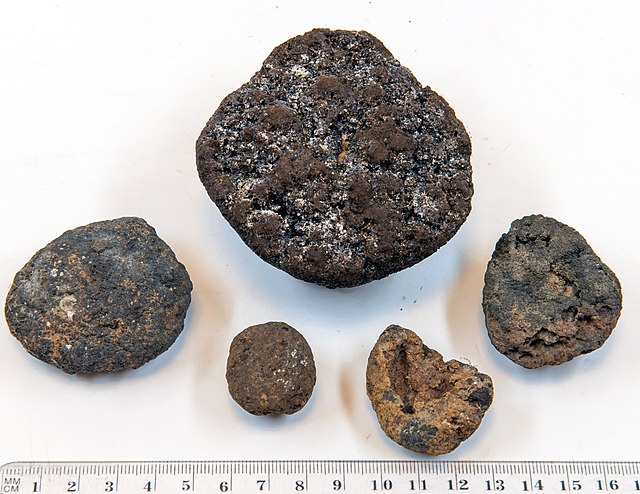
Many thousands of square kilometres of the deep-sea floor are covered by metal-bearing nodules. They contain primarily manganese, but also nickel, cobalt and copper, which makes them economically promising. Although many countries and companies are already intensively investigating their distribution, it is not certain whether the manganese nodules will ever be mined. After all, at least for the intermediate future, there are enough metals available on land.
noduli di manganese da Manganese nodules « World Ocean Review
Manganese nodules occur in many marine regions. They are found in significant abundances in four regions of the ocean:
CLARION-CLIPPERTON ZONE (CCZ)
With an area of around 9 million square kilometres, approximately the size of Europe, this is the world‘s largest manganese nodule region. The CCZ is located in the Pacific, extending from the west coast of Mexico to Hawaii. The nodules are not evenly distributed over this area. At some sites they are more densely grouped. No nodules at all are found in stony areas. On the average, one square metre in the Clarion-Clipperton Zone contains around 15 kilograms of manganese nodules. Especially rich areas can have up to 75 kilograms. The total mass of manganese nodules here is calculated to be around 21 billion tonnes.
PERU BASIN: The Peru Basin lies about 3000 kilometres off the Peruvian coast. It is about half as large as the Clarion-Clipperton Zone. The region contains an average of 10 kilograms of manganese nodules per square metre.
PENRHYN BASIN: The third important manganese nodule area in the Pacific is located in the Penrhyn Basin very near the Cook Islands, a few thousand kilometres east of Australia. It has an area of around 750,000 square kilometres. Large areas in the Cook Islands coastal waters have concentrations of over 25 kilograms of manganese nodules per square metre of sea floor.
INDIAN OCEAN: So far only a single large area of manganese nodules has been discovered here, with an area comparable to that of the Penrhyn Basin. It is located in the central Indian Ocean. Each square metre of the sea floor here contains around 5 kilograms of manganese nodules.
How nodules grow
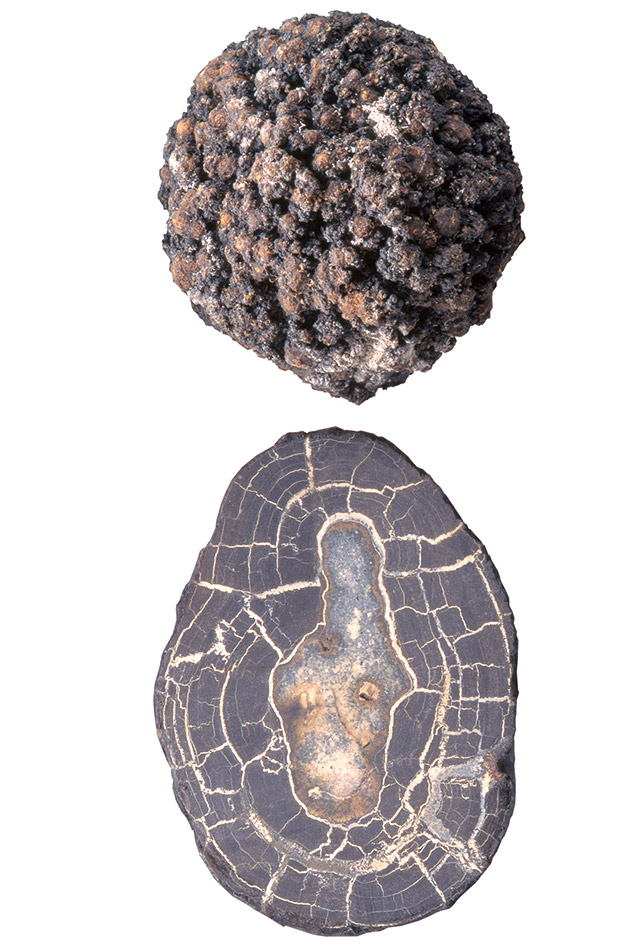
The formation of the manganese nodules is conceivably simple. Dissolved metal compounds in the sea water precipitate over time around a nucleus of some kind on the sea floor. The growth core can be, for example, a shark’s tooth or a fragment of a clam shell, around which the nodule grows. This growth process can take place in two ways. In the hydrogenous process, metal compounds sinking through the water are precipitated. In large part this involves the manganese oxide mineral vernadite, which forms naturally in water. Compounds of other metals join in smaller amounts.
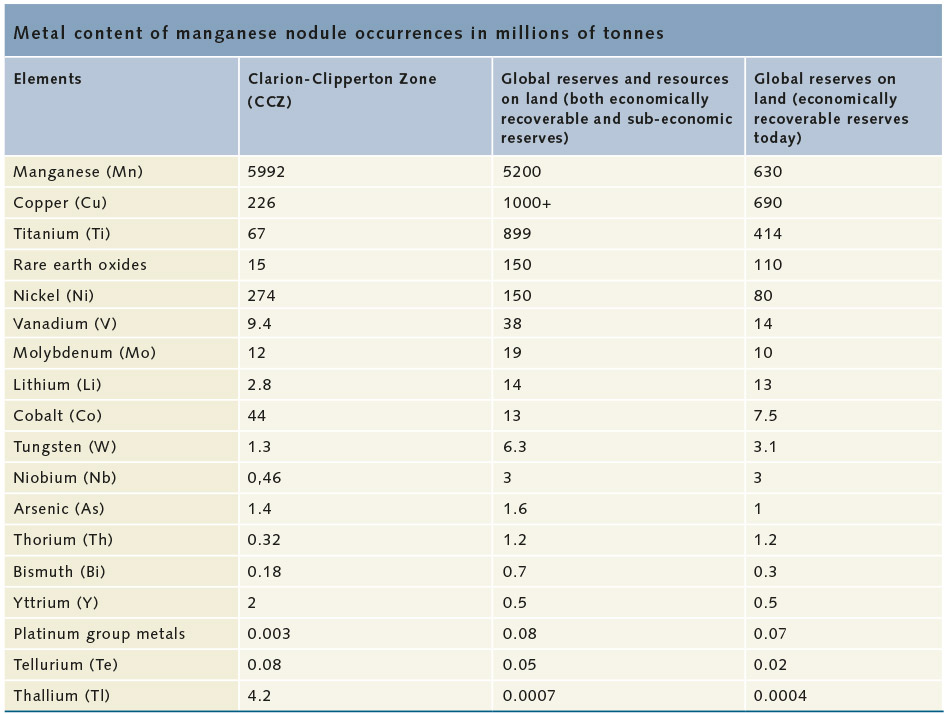
Worldwide, manganese nodule occurrences contain large amounts of metals. The occur-rences in the Clarion-Clipperton Zone (CCZ) alone hold around 10 times more manganese than the economically minable deposits on land today. The amount of thallium in the CCZ is even 6000 times more than in economically exploitable deposits. It must be kept in mind, however, that the possible marine deposits are compared to actual economic-ally recoverable occurrences on land. Whether, and how much metal can be obtained from manganese nodules in the future is completely uncertain. Manganese nodules « World Ocean Review
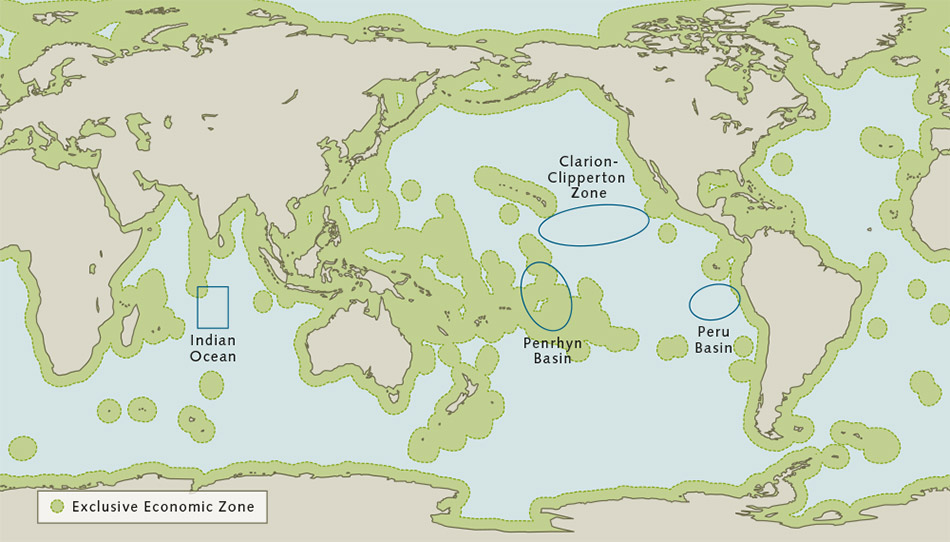
Manganese nodules occur in all oceans. But only in 4 regions is the density of nodules great enough for industrial exploitation – da https://worldoceanreview.com/en/wor-3/mineral-resources/manganese-nodules/
The second process is referred to as diagenetic growth. This process does not occur in the water column but within the sediments. Metal compounds that are present in the water between the sediment particles, the pore water, are deposited. This is sea water that penetrates into the sea floor and reacts with the sediments to become enriched with metal compounds. Where it rises up and out of the sediment, the metal compounds are likewise deposited around the nodule growth core. As a rule, this involves the manganese oxides todorokite and birnessite.
Most nodules grow both hydrogenously and diagenetically, whereby the relative influence of each process varies in different marine regions. It is fascinating how extremely slowly the manganese nodules grow. In a million years their size increases on the order of millimetres. Hydrogenous nodules grow up to 10 millimetres per million years, while diagenetic nodules grow between 10 and 100 millimetres. This means that manganese nodules can only grow in areas where the environmental conditions remain stable over this kind of time scale.
| The following factors are essential for the formation of manganese nodules |
| Low sedimentation rates of suspended material. Otherwise the nodules would be covered too rapidly |
| Constant flow of Antarctic bottom water. This water flushes fine sediment particles away that would otherwise bury the nodules over time. The coarser particles, such as the shells of small marine organisms and clam or nodule fragments, may be left behind to act as nuclei for new nodules |
| Good oxygen supply. The Antarctic bottom water, for example, transports oxygen-rich water from the sea surface to greater depths. Without this the manganese oxide compounds could not form |
| Aqueous sediment. The sediment has to be capable of holding large amounts of pore water |
| Diagenetic nodule growth can only take place in very aqueous sediments |

Manganese nodules are present in various quantities in different areas of the deep sea. In this close-up view of the Pacific sea floor, the nodules are relatively close together Manganese nodules « World Ocean Review
Furthermore, some researchers hold the opinion that bottom-dwelling organisms such as worms that burrow around in the sediment must be present in large numbers in order to constantly push the manganese nodules up to the sediment surface. This hypothesis, however, has not yet been proven
Different regions – different compositions
Although the conditions for the formation of manganese nodules are the same in all four of the major regions, their metal contents vary from place to place. The highest manganese content is 34 per cent in the Peru Basin nodules, while the highest iron content is in the Penrhyn Basin nodules with 16.1 per cent. The greatest content of cobalt, at a substantial 0.4 per cent, is also found here. In this area, therefore, the extraction of cobalt has the highest priority. According to expert estimations, 21 million tonnes of cobalt could be produced here, which is a great amount. The economically feasible reserves on land currently amount to around 7.5 million tonnes. Even adding the deposits on land that are not yet economically minable, only 13 million tonnes of cobalt could be retrieved – still significantly less than the nodules in the Penrhyn Basin could provide. After a record high before the economic crisis of 2008, however, the cobalt price has fallen steeply, so that mining of the deposits is not presently economical. Nevertheless, given the large amounts of metals that are contained in the manganese nodules worldwide, it is certainly conceivable that the nodules may be mined in certain marine regions in the future. For many countries that do not have access to their own land reserves, manganese nodules offer a way to become independent from imports.
Who owns resources in the sea?

Manganese nodules grow when metal compounds dissolved in the water column (hydrogenous growth) or in water contained in the sediments (diagenetic growth) are deposited around a nucleus. Most nodules are a product of both diagenetic and hydrogenous growth. Manganese nodules « World Ocean Review
The international Law of the Sea precisely regulates who can mine manganese nodules or massive sulphide and cobalt crusts in the future.
If the resources are located within the Exclusive Economic Zone (EEZ) of a country, the so-called 200 nautical mile zone, this country has the sole right to mine them or to award mining licences to foreign companies. This is the case, for example, in a part of the Penrhyn Basin near the Cook Islands. The CCZ, the Peru Basin, and the Indian Ocean area, on the other hand, all lie far outside the Exclusive Economic Zones, in the realm of the high seas. Here, mining is centrally regulated by an agency of the United Nations, the International Seabed Authority (ISA), with headquarters in Kingston, Jamaica. In particular, the ISA ensures that the benefits from future activities related to marine mining are shared equitably. Its authority is based on various articles of the United Nations Convention on the Law of the Sea, which define the high seas as the common heritage of mankind. Activities on the high seas should thus serve the good of all people. Among other things, exclusive access to the promising resources in the deep sea by rich countries should be prevented. For the manganese nodule areas this means that contractors apply to the ISA for an exploration area of up to 150,000 square kilometres. The individual contractor must pay a licence fee for these areas. The crucial condition is that the countries can only use half of their licence area, or a maximum of 75,000 square kilometres. After preliminary exploration, the other half is reserved for developing states.
So far, the ISA has awarded 12 licences for the Clarion-Clipperton Zone and one for the Indian Ocean, all to various states. The contractors are China, Germany, France, India, Japan, the Russian Federation, South Korea, and the Interoceanmetal Joint Organization, a consortium of Bulgaria, the Czech Republic, Slovakia, Poland, the Russian Federation and Cuba.
Two commercial companies have recently joined the applicants: the British company UK Seabed Resources Limited and the Belgian G-TEC Sea Mineral Resources NV. Since 2011 a number of developing countries (Nauru, Kiribati and Tonga) have submitted applications in cooperation with industrialized-country companies. These applications are related to areas explored by the original contractors and reserved for developing countries, which will now be consigned to Nauru, Kiribati and Tonga. The financial and technical means for further exploration and eventual development of these areas, however, will not be supplied by the 3 island nations but by the industry partners.
Up to now, the licences awarded by the ISA have all been exploration licences, which allow nations to investigate the potential mining areas more closely. This includes detailed studies to determine which parts of the region have the highest densities of nodules or nodules with especially high metal contents. The licences are awarded for a period of 15 years and can be extended one time for 5 more years. After that the mining must begin or the country will forfeit its mining rights. However, the ISA will not define the legal regulatory framework for future mining until 2016. There are still a number of unresolved questions. The mining techniques to be used in the future to harvest nodules have still not been determined, and there is no plan in place for effective protection of the marine environment from large-scale mining.
Part I – continue
for the original article follow this link
Alcune delle immagini possono essere state prese dal web, citandone ove possibile gli autori e/o le fonti. Se qualcuno desiderasse specificarne l’autore e la fonte o rimuoverle, può scrivere a infoocean4future@gmail.com e provvederemo immediatamente alla correzione dell’articolo
.
PAGINA PRINCIPALE
.
PARTE I PARTE II
.

- autore
- ultimi articoli

è composta da oltre 60 collaboratori che lavorano in smart working, selezionati tra esperti di settore di diverse discipline. Hanno il compito di selezionare argomenti di particolare interesse, redigendo articoli basati su studi recenti. I contenuti degli stessi restano di responsabilità degli autori che sono ovviamente sempre citati. Eventuali quesiti possono essere inviati alla Redazione (infoocean4future@gmail.com) che, quando possibile, provvederà ad inoltrarli agli Autori.