.
livello medio.
ARGOMENTO: EMERGENZE AMBIENTALI
PERIODO: XXI SECOLO
AREA: DIDATTICA
parole chiave: rischio ambientale marino
.
Environmental risk assessment of marine activities – part II
credit to Jan-Bart Calewaert et alii. Original article published by www.coastalwiki.org
Problem Formulation
The problem formulation step is crucial in ERA. Initially the problem has to be defined and certain issues must be clear before the assessment starts:[4][5]
– What are the risk sources we want to assess? Are these point sources (e.g. wind energy parks) or mobile sources (e.g., maritime transport, fishing fleets) and what are the characteristics of these risk sources? Are we concerned with the production, use or disposal of the hazard?
– What are the environmental hazards to be taken into account: mineral oil, chemicals, garbage, sewage, ballast water, tributyltin, emissions, noise etc.;
– Which are the pathways in which the created hazard can reach the receptor, and which are the receptors and endpoints?
– Will we focus on pre-defined sensitive ecosystems (e.g. special areas of conservation under the Habitats Directive, EC Birds Directive or areas with a high value in recreational amenity or commercially exploitable biological resources) or do we cover the risks for a broader area?
At this stage, a generic model should be defined to describe the functions, features, characteristics and attributes of the system under investigation. Other questions that need to be handled in this first step are those related to legal and policy frameworks relevant to the risk assessment. Will we rely on regulatory standards and policy frameworks as a guide to determine “acceptable” risk and the significance of including specific end-points? Is there a legal framework that determines how we should approach the risk assessment?[4]
Fonte https://www.researchgate.net/publication/…..
Hazard Identification
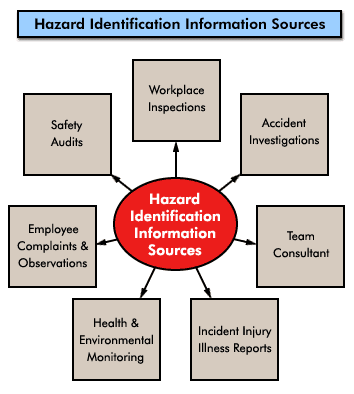
The purpose of this step is to identify all of the conceivable and relevant hazards that could possibly cause harm to the receptor of interest. The identification may involve the establishment of those agents that may cause harm and working backwards to identify how this harm could occur. Alternatively, hazard identification may arise from examining all possible outcomes of routine operation and identifying the consequences from normal operation.[4] The hazards identification step is closely linked to the next step, release assessment in the sense that these steps are both risk source related while the exposure and consequence steps are risk receptor related. Often, no distinction is made between hazard identification and release assessment and is simply denominated as “hazard identification”.
Release Assessment
The Release Assessment step involves the identification of the potential of the risk source to introduce hazardous agents into the environment. This may be descriptive or involve the quantification of the release. Release assessment attempts to give a measure of the likelihood of a release. It will include a description of the types, amounts, timings and probabilities of the release of hazards into the environment and a description of how these attributes might change as a result of various actions or events.[4]
Release assessment is also risk source related and therefore often executed together with the hazard identification step. In quantitative risk analysis (QRA), a quantitative estimation of the probability of release can be approached in two ways: the historical approach which uses direct statistical data on the system under investigation. This may be collected monitoring data or data from similar marine activities. This includes data on undesired events as well as data on recovery and control measures which mitigates the potential impacts;- the approach which uses analytical and simulation techniques, breaking the system down into contributing factors and causes. Collected monitoring data or data from similar marine activities are also used to verify the modelling results.
Expert judgement can be used to estimate the likelihood or probability of a release of hazards in a non-quantitative way. Based on the results of the hazard identification, the likelihood is divided in different categories in terms of terms of expressions as likely, may occur, not likely, very unlikely.[1]
Exposure Assessment
Exposure assessment attempts to quantify the potential exposure levels of the hazard at the receptor site. It includes a description of the intensity, frequency and duration of exposure through the various exposure media (routes of exposure) and the nature of the population exposed. Risk assessment on ecosystems has to deal with a multitude of organisms, all with varying sensitivities to chemicals and various groups have distinct exposure scenarios (e.g. free swimming species have another exposure pathway than benthonic species).
The exposure assessment step requires the use of monitoring data, exposure modelling techniques and also mapping models to locate ecological sensitivity incorporating GIS techniques.[4][6] Most of the time, exposure of ecosystems to produced hazards is determined in terms of the Predicted Environmental Concentration (PEC). The PEC is calculated on both local and regional spatial scales from monitoring data where available (also called Monitored Environmental Concentration (MEC)), or by using realistic worst-case scenarios. If this information is not available, estimates are made from exposure models. The PEC is calculated for each environmental compartment using the information available on release quantities and subsequent degradation processes in the “standard” environment. Site-specific information is used when available and appropriate.
The relevant compartments of the marine environment are [6]:
– Water-exposure of aquatic organisms across respiratory and other permeable surfaces;
– Sediment-exposure of sediment dwelling (benthic) organisms by ingestion of, or direct contact with, sediment particles;
– Biota-exposure of higher trophic levels via the food chain (secondary poisoning), by predation on organisms that have been exposed via the water, sediment or predation on other organisms;
– Air-exposure for marine birds and mammals by inhalation of the chemical in the air they breath (likely less significant than the other three).
Consequence or Effect Assessment
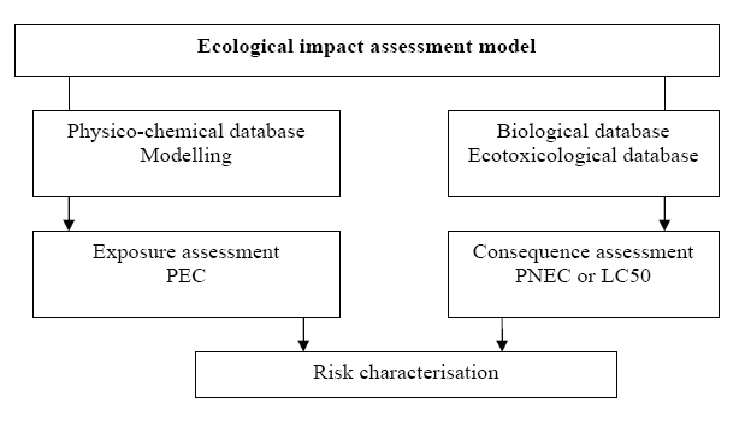 A Consequence Assessment will examine the consequences of the release or production of the hazards, to the specified population and the quantification of the relationship between specified exposures to the hazard and the consequences of those exposures. The consequences examined in ecological systems are varied and few defined end-points exist at present. Environmental risk assessment on ecosystems is concerned with different populations and communities and the effects of substances on their mortality and fecundity.[4]In ecological impact assessment, the consequences or effects can be estimated in terms of the Predicted No Effect Concentration (PNEC) (based on EC Directive 93/67/EEC).
Separate PNEC values need to be derived for the relevant compartments of interest: water compartment, benthic compartment (sediments) and biota (representing organisms which are eaten by avian and mammalian predators). PNEC values can be derived using ecotoxicity tests. In these tests, the estimation of the PNEC is primarily made on the basis of results from monospecies laboratory tests or, in some cases, from model ecosystem tests. The available ecotoxicity data are used to derive a No Observed Effect Concentration (NOEC) or a Lowest Observed Effect Concentration (LOEC). The test species used are selected to represent the sensitivities of different taxonomic groups in each environmental compartment. For aquatic effects assessments, ecotoxicity data are required on representatives of fish species, daphnia and algae.[4]
Assessment (safety) factors are applied to the toxicity value to enable extrapolation from laboratory experiments to the field, acute to chronic effects and for inter and intra species variations. The size of the assessment factor varies according to the number and type of data available and the likely duration of exposure.[4][6]
Ecotoxicological Assessment Criteria (EACs) are defined as effects benchmarks against which the results of environmental monitoring can be assessed in an attempt to identify possible areas of concern. The determination of EACs is based on the same principles as for the assessment factors. EACs are only derived when data which meet predefined quality criteria are available from at least three species.Expert judgement may also be used to assess the magnitude of the consequences in qualitative terms. Dependent on the pollution source and ecosystem characteristics, the potential consequences on the ecosystem are divided in different categories (e.g. “minor” to “catastrophic”).[1]
to be continued
References
- Wilcox R. LT. Burrows M. CDR. Ghosh S. and Ayyub B. M. (2000). Risk-based Technology for the Safety Assessment of Marine Compressed Natural Gas Fuel Systems. International Cooperation on Marine Engineering Systems/The Society of Naval Architects and Marine Engineers. Paper presented at the 8th ICMES/SNAME New York Metropolitan Section Symposium in New York, May 22-23, 2000.
- Stern P. C. and Fineberg H. V. (eds.) (1996). Understanding Risk – Informing Decisions in a Democratic Society. Committee on Risk Characterization, Commission on Behavioural and Social Sciences and Education – National Research Council.
- Covello, V.T. and Merkhofer, M.W. (1993). Risk Assessment Methods Approaches for Assessing Health and Environmental Risks. Plenum, New York
- Fairman R., Mead C. D. and Williams W. P. (1999). Environmental Risk Assessment – Approaches, Experiences and Information Sources. Monitoring and Assessment Research centre, King’s College, London. Published by European Environment Agency – EEA Environmental issue report No 4.[1]
- MacDonald A., McGeehan C., Cain M., Beattie J., Holt H., Zhou R. and Farquhar, D. (1999). Identification of Marine Environmental High Risk Areas (MEHRA’s) in the UK. Department of the Environment, Transport and the Regions, ST-87639-MI-1-Rev 01, London, UK.
- ECOTOC (2001). Risk Assessment in Marine Environments. Technical Report No. 82. ISSN -0773- 8072-82. European Centre For Ecotoxicology and Toxicology of Chemicals, Brussels.
See also
- References for environmental risk assessment
- Case study risk analysis of marine activities in the Belgian part of the North Sea
Le Roy D., Volckaert A., Vermoote S., De Wachter B., Maes F., Coene J. and Calewaert JB. (2006). Risk analysis of marine activities in the Belgian Part of the North Sea (RAMA). Research in the framework of the BELSPO Global change, ecosystems and biodiversity – SPSDII, April 2006, 107 pp + Annexes. Available at [2]
Alcune delle immagini possono essere state prese dal web, citandone ove possibile gli autori e/o le fonti. Se qualcuno desiderasse specificarne l’autore o rimuoverle, può scrivere a infoocean4future@gmail.com e provvederemo immediatamente alla correzione dell’articolo
,
PARTE I PARTE II PARTE III
,
.

- autore
- ultimi articoli
è composta da oltre 60 collaboratori che lavorano in smart working, selezionati tra esperti di settore di diverse discipline. Hanno il compito di selezionare argomenti di particolare interesse, redigendo articoli basati su studi recenti. I contenuti degli stessi restano di responsabilità degli autori che sono ovviamente sempre citati. Eventuali quesiti possono essere inviati alla Redazione (infoocean4future@gmail.com) che, quando possibile, provvederà ad inoltrarli agli Autori.